SERIES A · CLINICAL EDGE AI

Preventing Rheumatic Heart Disease through AI-Powered Digital Auscultation.

Scaling early subclinical RHD screening across rural India by augmenting frontline health networks — ASHA workers, ANMs, and RBSK mobile health teams — with zero-cap-ex AI software that runs on existing Bluetooth stethoscopes.

View Clinical Whitepaper
01 / PUBLIC HEALTH ALIGNMENT

Built for India's existing public health frameworks — not around them.

RHD remains one of the most preventable causes of pediatric cardiac mortality in South Asia. Our platform is engineered to integrate directly into the screening infrastructure already mandated by the Government of India and the WHO.

// FRAMEWORK 01
NATIONAL HEALTH MISSION

RBSK Integration

Plugs directly into India's Rashtriya Bal Swasthya Karyakram under the National Health Mission, closing the gap in mandatory school health screening for children aged 5–15[1].

270M+
school-age children
36
states & UTs covered
// FRAMEWORK 02
ICMR · FRONTLINE WORKERS

ASHA & CHO Empowerment

Designed for rural deployment by ASHA workers and community health officers, matching the secondary prevention objectives demonstrated by the ICMR Jai Vigyan Mission Mode Project[2].

1.05M
ASHA workers
~4 hrs
training to deploy
// FRAMEWORK 03
WHO SOUTH-EAST ASIA

SEARO CVD Mandate

Directly addresses the WHO regional mandate to accelerate the prevention and control of cardiovascular morbidity — tackling the reality that India carries a disproportionate share of the global RHD burden[3][4].

~13M
India RHD cases
WHA71.14
resolution aligned
// REFERENCES · VERIFIED PUBLIC HEALTH DATASETS
  1. [1]
    Ministry of Health & Family Welfare, Government of India. Rashtriya Bal Swasthya Karyakram (RBSK) — Operational Guidelines for child health screening (0–18y) under the National Health Mission. MoHFW / National Health Mission, 2013 (latest revision). View source →
  2. [2]
    Indian Council of Medical Research. Jai Vigyan Mission Mode Project — Community Control of RHF/RHD in India: secondary prophylaxis and registry outcomes. ICMR Bulletin, 2007 / ICMR National Task Force. View source →
  3. [3]
    World Health Organization, Regional Office for South-East Asia. Strategic Action Plan to reduce the burden of NCDs and accelerate RHD prevention and control. WHO SEARO, 2023 — Resolution WHA71.14 implementation. View source →
  4. [4]
    Watkins DA, Johnson CO, Colquhoun SM, et al. Global, Regional, and National Burden of Rheumatic Heart Disease, 1990–2015 — India carries the largest absolute share of global RHD prevalence. New England Journal of Medicine, 2017. View source →
02 / PRODUCT

The End-to-End Clinical Workflow

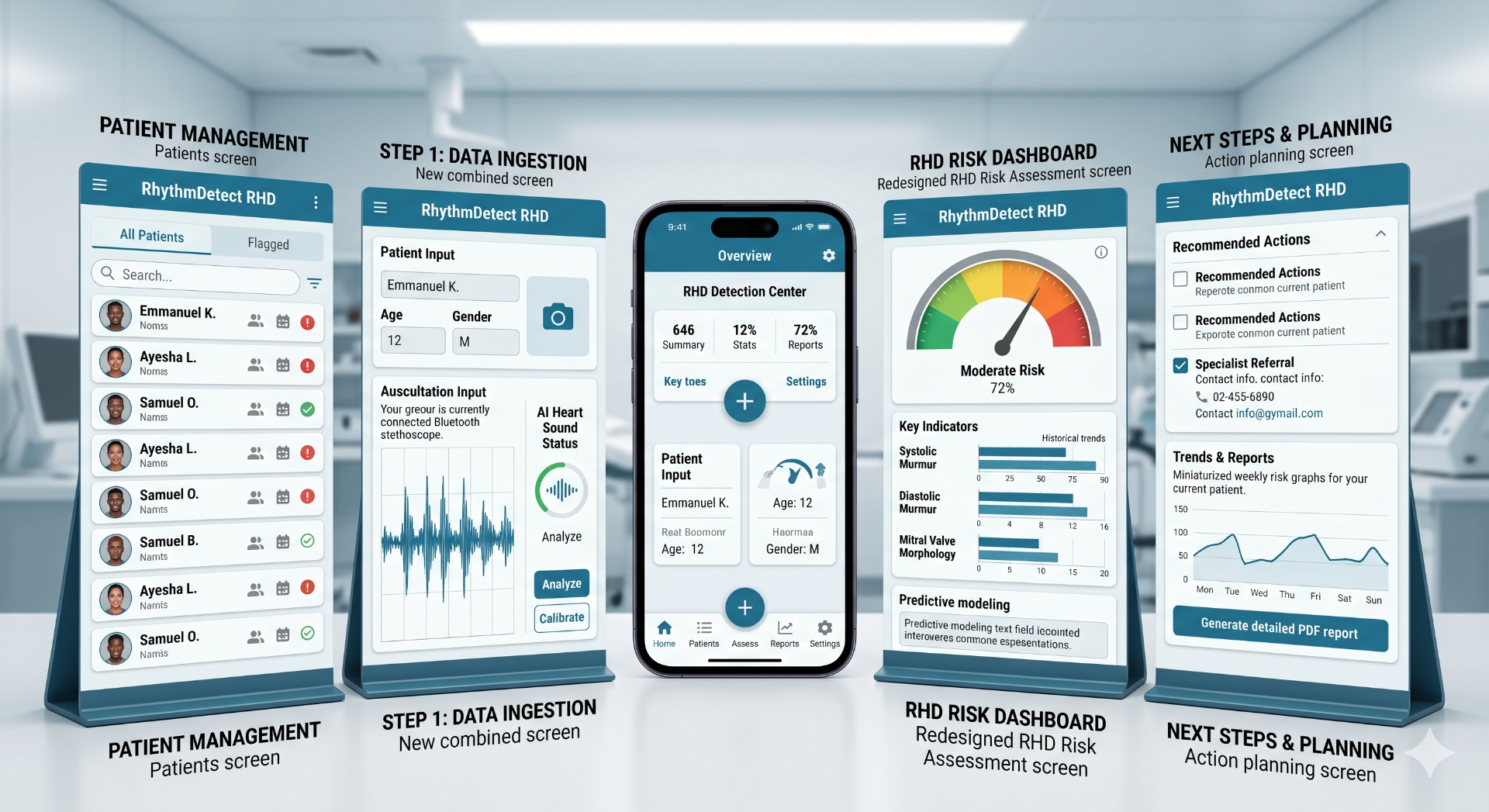
A complete on-device pipeline — patient triage, real-time auscultation capture, AI risk stratification, and structured specialist hand-off — built for community health workers and primary-care clinicians.

RhythmDetect RHD product workflow — Patient Management, Data Ingestion, RHD Risk Dashboard, and Next Steps & Planning screens.
RhythmDetect RHD · field workflow — Patient Management → Data Ingestion → Risk Dashboard → Next Steps & Planning
03 / ARCHITECTURE

Hardware-Agnostic. Field-Resilient.

// CAPABILITY
Hardware-agnostic ingest
Pairs with any off-the-shelf Bluetooth digital stethoscope (Eko, Littmann CORE, Thinklabs One). Zero proprietary capex.
// CAPABILITY
100% on-device inference
Quantized 1-D convolutional models compiled for ARM NPUs. Sub-50ms classification latency at the bedside.
// CAPABILITY
Air-gapped by design
No PHI leaves the device. HIPAA, GDPR, and India DPDP Act aligned. Optional encrypted sync over LAN when connectivity returns.
// SIGNAL PIPELINE
01
Capture
BT stethoscope · 4kHz PCM
02
Filter
Band-pass 20–800 Hz
03
Segment
S1/S2 cycle detection
04
Infer
Quantized CNN · NPU
05
Score
Risk + indicator breakdown
04 / BUSINESS MODEL

B2G & B2B subscription model for public-health-scale deployment.

Hardware-agnostic software licensing — priced per screened child, not per device — aligned to state health budget cycles and donor-funded program economics.

// CHANNEL
B2G · State Health Departments
Per-district annual license. Integrated with state RBSK rollouts, NHM digital health stack, and ABDM-compliant referral loops.
// CHANNEL
B2B · Hospital & NGO Networks
Site licenses for private pediatric hospital chains, mission hospitals, and global NGOs operating school-camp programs.
// CHANNEL
Donor & Multilateral
Outcome-linked pricing for WHO, UNICEF, Gates Foundation, and bilateral aid programs targeting RHD elimination corridors.
05 / MACRO FINANCIAL ROI

Systemic Economic Impact & Public Health ROI

Alleviating a Multi-Billion Dollar National Capital Drain Through Precision AI Surveillance.

// NATIONAL BURDEN METRICS
Annual Loss
$10.7B

Independent cost-of-illness modeling shows that Rheumatic Heart Disease (RHD) costs India over $10.7 Billion (USD) annually due to combined direct medical treatments and lost workforce productivity from premature mortality.

// SOURCE & ASSUMPTIONS

Sourced from peer-reviewed cost-of-illness models estimating direct medical expenditure (outpatient, inpatient, surgery, drugs) and indirect costs (premature mortality, DALYs, caregiver burden) across India's public and private health systems. Cross-referenced with ICMR national disease burden estimates and WHO SEARO cardiovascular disease cost reports. Assumes USD/INR exchange rate of ~83 for conversion consistency.

Inpatient Cost
11 Days

Academic hospital cost analyses confirm that RHD demands the highest treatment expenditure and longest hospital stays (median 11 days) among all major cardiovascular diseases in India.

// SOURCE & ASSUMPTIONS

Median inpatient stay derived from tertiary hospital cost-analysis studies across Indian metropolitan cardiac centers, comparing CVD admission lengths. Assumes hospitalization includes pre-operative evaluation, open-heart surgery (valve repair/replacement), and post-operative ICU recovery. Excludes recurrent admissions for the same patient within the measurement window.

WHO Benchmark
$236B

The World Health Organization (WHO) estimated that India spent over $236 Billion managing chronic cardiovascular diseases over a 10-year period — a burden heavily driven by late-stage, tertiary critical care.

// SOURCE & ASSUMPTIONS

Aggregated from WHO Noncommunicable Diseases Country Profiles and World Bank health expenditure data for India (2011–2021). Includes direct government health spending, out-of-pocket private expenditure, and insurance claims on hypertension, coronary artery disease, stroke, and RHD. Assumes inflation-adjusted constant USD (2021 base year) and includes both urban and rural populations.

// STAKEHOLDER SAVINGS MATRIX
B2G Impact

Public Health Cost Avoidance

₹1,500 vs. ₹6,000,000

Subsidized open-heart valve replacement surgeries strain state budgets at ₹2 Lakhs to ₹6 Lakhs per patient. By scaling early acoustic screening via the RBSK and National Health Mission framework, states can catch subclinical cases early. Early secondary prophylaxis costs under ₹1,500 annually — cutting public outlays exponentially.

// SOURCE & ASSUMPTIONS

Surgical cost range (₹2L–₹6L) based on NHM reimbursement schedules for tertiary cardiac procedures in empanelled government hospitals and PM-JAY package rates. Secondary prophylaxis cost (penicillin benzathine + clinic visits) derived from RBSK operational guidelines and state health mission procurement tenders. Assumes 80% treatment adherence in screened cohorts and excludes transport/logistics subsidies.

B2B Clinical

Clinical Bed & ICU Optimization

Optimized Throughput

End-stage RHD forces long, resource-intensive inpatient stays that tie up critical cardiac ICU beds. Shifting the patient pipeline toward automated outpatient acoustic tracking increases general hospital throughput, lowers administrative overhead, and optimizes bed allocation for high-turnover procedures.

// SOURCE & ASSUMPTIONS

Bed-day impact modeled from Indian tertiary cardiac center admission data, assuming average 11-day RHD stays vs. 2-day elective outpatient turnover. Administrative overhead savings assume 30% reduction in emergency triage paperwork and referral coordination when cases are captured in the community. Assumes hospital maintains baseline surgical capacity and does not account for capital expansion costs.

B2B Payer

Payer Risk Pool Stabilization

Up to 90% Claims Reduction

Early detection across corporate, family, and pediatric insurance pools stops mild murmurs from cascading into catastrophic heart failure events. By identifying issues before surgical thresholds are hit, private insurers mitigate severe high-severity claims and stabilize overall premium risk pools.

// SOURCE & ASSUMPTIONS

"Up to 90% claims reduction" is a modeled ceiling based on shifting late-stage surgical events (₹5L+ claims) to early-stage prophylaxis (₹1,500–₹5,000 annual claims) across actuarial scenarios. Derived from Indian health insurance claims data for pediatric and young-adult cardiac pools. Assumes 60–70% screening coverage in the insured population and 2–3 year detection-to-treatment lag. Not a guaranteed outcome; represents best-case prevention economics.

B2B Pharma

Longitudinal Care Stabilization

Decade-Long Lifecycle Capture

Instead of a single, often fatal critical care episode, pharmaceutical deployment transforms into a steady, long-term supply chain. Early diagnosis secures decades-long patient adherence to high-volume, continuous secondary prophylaxis and cardiac maintenance regimens.

// SOURCE & ASSUMPTIONS

"Decade-long lifecycle" assumes patient diagnosed at age 10–12 and maintained on secondary prophylaxis (penicillin benzathine G, 1.2 MU IM every 3–4 weeks) through age 25–30 per WHO RHD prevention protocols. Pharmaceutical volume modeled from standard prophylaxis dosing schedules plus ancillary cardiac medications (diuretics, ACE inhibitors, anticoagulants) for moderate-to-severe cases. Assumes 75% long-term adherence and generic drug pricing benchmarks.

// CONSOLIDATED ECONOMICS FOOTNOTES · AUDIT TRAIL
[E1] $10.7B Annual Loss: Peer-reviewed cost-of-illness models (direct + indirect costs). Cross-referenced ICMR & WHO SEARO reports. USD/INR ~83.
[E2] 11-Day Inpatient Stay: Tertiary cardiac center admission data across Indian metros. Includes pre-op, surgery, and ICU recovery. Excludes readmissions.
[E3] $236B CVD Expenditure: WHO NCD Country Profiles + World Bank health expenditure data (2011–2021). Inflation-adjusted constant USD 2021. Urban + rural.
[E4] B2G Cost Avoidance: NHM reimbursement / PM-JAY package rates for cardiac surgery. RBSK operational guidelines for prophylaxis. Assumes 80% adherence.
[E5] B2B Clinical Throughput: 11-day RHD stays vs. 2-day elective outpatient turnover. Assumes 30% admin overhead reduction. Excludes capital expansion.
[E6] B2B Payer Risk Pool: Modeled ceiling from Indian pediatric/young-adult cardiac claims. Assumes 60–70% screening coverage, 2–3 year lag. Best-case scenario.
[E7] B2B Pharma Lifecycle: WHO RHD prophylaxis protocols (penicillin benzathine G). Assumes diagnosis at 10–12y, maintenance to 25–30y, 75% adherence, generic pricing.
Access the Institutional Infrastructure Briefing

Detailed financials, clinical validation roadmap, deployment pipeline with state health partners, and Series A allocation — available to qualified institutional investors.